

Metallic epoxy
worked by hand while it is wet
for Madison living rooms and showrooms
Pigment moved through clear resin over a ground slab, so light and color settle into a pattern that belongs to that one room.
Talk to KortniFree quote . No obligation . Fast response
What you decide, and what the resin decides
A metallic floor is pigment carried in clear resin and moved around while it is still wet. Some of the result is yours to choose. Some of it belongs to the resin and the way it flows across your particular slab, and nobody can promise you a copy of a photograph.
- Colors are yours. You pick the metallic pigments, copper and silver, bronze and brown, or whatever the room is asking for. We talk the combination through with you before the first bucket is opened.
- Direction is partly yours. How the pigment is moved decides where the light pools and where the color goes dark, so we agree on which way the movement should run across the room, toward a window or down a hallway.
- The exact pattern is the resin’s. Pigment drifts and settles as the floor levels out. You will get the colors and the general direction you asked for, and the details inside them will be the floor’s own.
- The light is the room’s. A floor with windows down one wall shows movement that a windowless basement will hide, and the same pour looks different at noon than under the lights at night.
That split is the honest version of metallic. Anyone who promises a pattern down to the last swirl is promising something the resin will not allow. Bring us the room you have in mind and a few photos of floors you like, and we will tell you which parts of them can carry over.
An empty room and taped edges
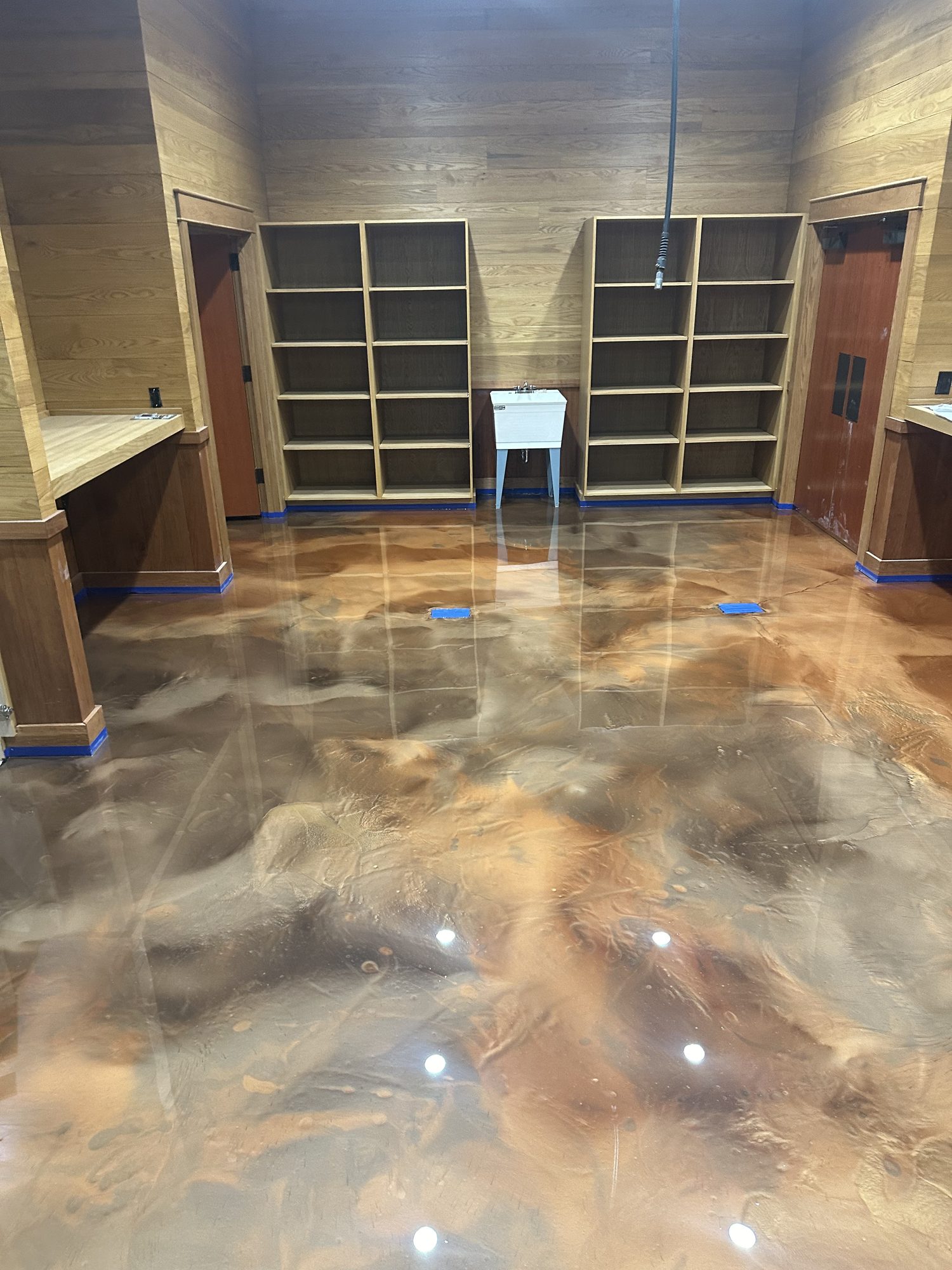
Metallic is the least forgiving system we put down while it is wet. Anything that lands in the resin during the pour stays in it, whether that is dust drifting in from the next room or a bug drawn to the work lights. So the room gets emptied completely and stays shut until the floor has set.
The edges get the same care. In the room pictured here, the built in shelving is empty and the blue edge tape is still on the baseboards from the pour. Taping the trim keeps resin off the woodwork while the floor runs right up to the wall.
Before any of that, the slab is diamond ground to open it up and take off old sealer, then cracks and pits are filled. Bubbles and pinholes in a metallic floor usually come from air leaving the concrete while the resin is wet, so we time the pour to the temperature of the slab, which is not always the temperature of the air.
What to clear before we come
Everything that sits on the floor comes out, furniture and rugs included, along with whatever is stored in closets on the same slab. Anything mounted low on the wall that can come down should, since we cut in behind it otherwise. The more open floor we start with, the cleaner the edges come out.
Rooms in a Madison house that suit it
Much of Madison is houses built in the last thirty years with big two and three car garages. Those garages usually end up with flake, and the reasons are on our Madison flake epoxy page.
In a room you use every day, the floor is a big part of how it feels, so the color and direction talk is worth taking slowly. We would rather answer the same question twice than have you surprised when the tape comes off.
Inside the house, metallic suits the rooms where the floor is meant to be looked at: a bonus room, a finished basement, or a living room with a stacked stone fireplace like the one at the top of this page.
Kortni loves the art side of this trade, and metallic is where the owner’s hand shows most. Two rooms poured from the same buckets on the same day will still come out different, because the movement is worked by hand and the resin finishes it in its own way. Every floor ends up with a character nobody else has, which is exactly why people pick it.
Basements need one extra check. If moisture is coming up through the slab, it will push a resin floor off from underneath, and a mirror finish will show the first spot that lifts. We look for that during the grind, and if the slab is not worth coating, we tell you before any money changes hands.
Mirror finishes in working buildings

Metallic works outside the house too. Showrooms, offices, retail floors and long corridors take it well, like the copper floor running down this wood paneled hallway past the drinking fountains and lockers. A corridor gives the movement a direction to follow, which suits a floor people mostly see while walking. In Madison that points to the retail along County Line Road and the working buildings around a commuter base tied to Research Park and Redstone.
Plan for the shine. A metallic floor reflects like still water, so every window and light fixture shows up in it, and so does dust. Where the sun comes in low it can throw glare, which suits a showroom and can wear on someone working at a desk all day. If glare worries you, tell us where the windows are and which way the room faces before colors get picked. Office and retail floors also see more grit carried in from outside than a living room does, so a mat at the door earns its keep on a metallic floor.
More on how we install it is on the main metallic epoxy page, and there are finished floors to look through in our gallery. For everything else we do around town, see the Madison page. If you have a room in mind, describe it to us or call Kortni at (205) 238-8111.
Before you pick a metallic floor
The questions that come up when someone is deciding whether a room can carry it.
Can you match a floor I saw in a photo?
We can get close on color and on the general direction of the movement. The exact pattern belongs to the resin as it levels, so no metallic floor repeats another one. Bring the photo anyway, because it tells us what you like about it, and that is usually what we aim for.
Will two rooms in the same house match?
They will share colors and a family resemblance if we pour them from the same mix, and the details will differ. You can run one combination through connected rooms and enjoy the variation, or pick a different combination for each room so the difference looks intended. We talk it through before the pour.
Will furniture legs or a rolling chair mark it?
Anything dragged across a glossy floor can mark it, the same as hardwood. Put felt pads on chair and table legs, lift heavy pieces into place rather than sliding them, and use a mat under a rolling desk chair. Rugs need a backing that will not hold grit against the finish.
Can metallic go on a garage floor?
It can be done, but think it through. Hot tires pull at a coating in a way foot traffic does not, and a glossy metallic shows tire marks and dust. Most garages here are better served by flake, which hides small marks, and metallic is usually saved for rooms where the floor is on show.
What goes over the metallic layer?
A polyaspartic clear coat goes over the top and locks the metallic pattern in. That clear is what you walk on, so it takes the wear instead of the color underneath. Foot traffic is usually the next day, and we will tell you when furniture can go back in.
Can you pour around built ins or a kitchen island?
We can work around a few fixed items, such as built ins or a kitchen island that is staying, and cut the edges in by hand. On metallic, though, every place the pour stops shows in the finish, so the more floor that is open, the better the whole room reads.
The other Madison systems
Tell us about the room
Send a few photos and the size of the space, or call, and Kortni will tell you whether metallic suits it.