

Metallic floors
for the rooms
where you spend your evenings
Pigment is pushed through clear resin while it is still open, over a slab that has been ground and repaired first.
Talk to KortniFree quote . No obligation . Fast response
Why metallic stays indoors
Metallic is a floor for rooms with furniture in them. It is glossy and deep, and it reflects whatever sits above it, which is exactly the point in a bonus room or a finished basement and exactly the trouble under a parked car.
A garage needs a coating that hides tire marks, grit and drips, and a metallic floor puts all of them on display. A porch adds direct sun on top of that. For either one we would point you to our Harvest flake page, since chip is built for that kind of use.
Inside the house, the gloss that would show a tire mark shows depth instead, and light moves across it as you walk the room. How we install it, layer by layer, is on our main metallic epoxy page.
Rooms where it earns its place
- Finished basements. Usually cool and lit by fixtures more than windows, so color gets picked under those lights.
- Bonus and game rooms. Where a slab carries the room, metallic turns the floor into the thing people notice first.
- Living areas on a slab. Older homesteads especially, once carpet or tile and the glue under it come up.
- Offices and showrooms. Harvest has working buildings too, and a front room that customers walk into suits it.
What the window puts in the floor
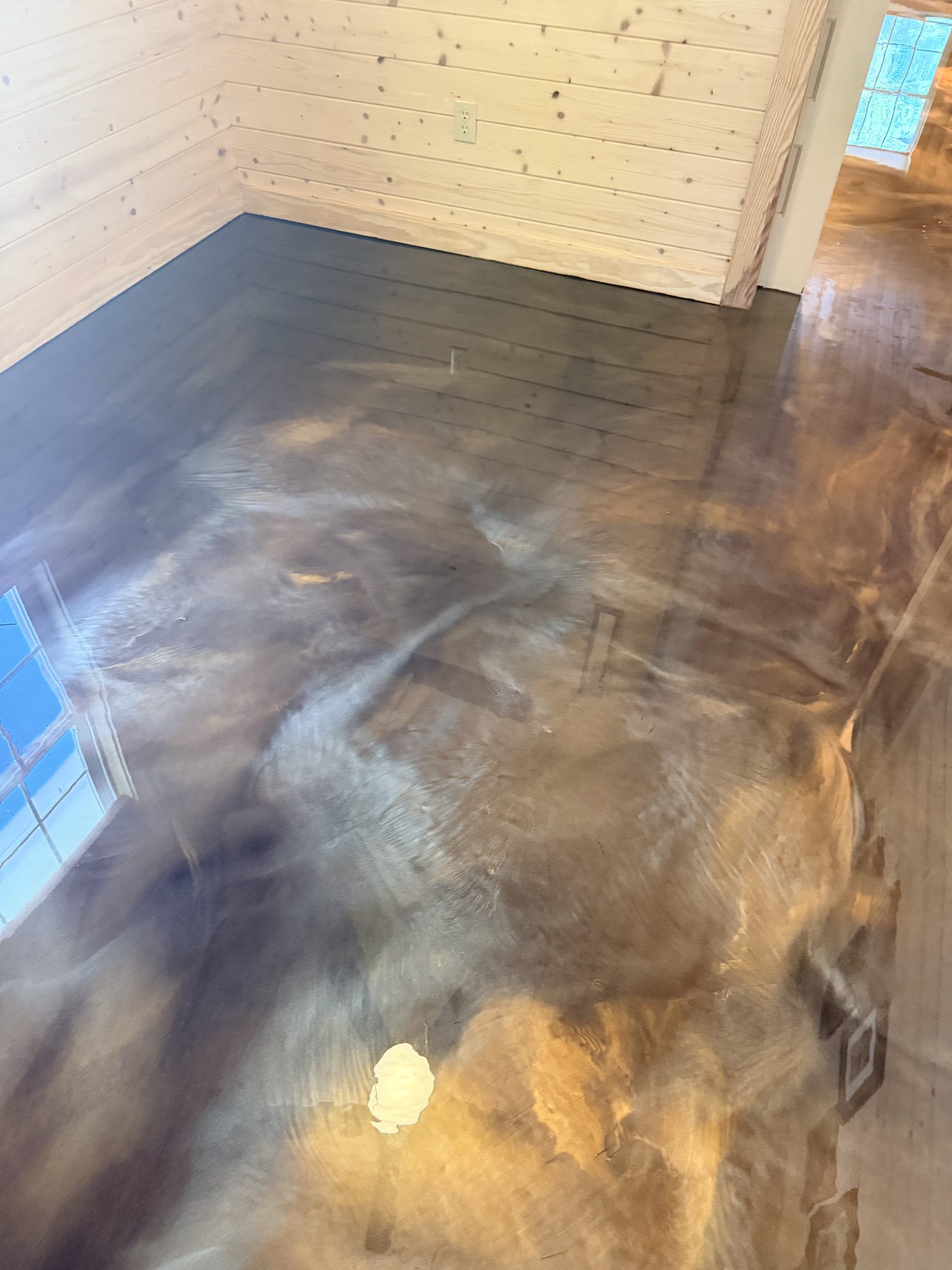
The room in this photo has pine plank walls and a warm brown metallic floor, and a window shows right there in the gloss. That reflection is part of the floor now. Wherever daylight crosses a metallic surface the movement in the pigment shows plainly, and in a corner the light never reaches, the same pour reads darker and quieter.
The warm brown in this room works with the pine because both lean the same direction. A cool gray metallic against the same walls would have fought them. Wood, brick and painted trim all pull a floor one way or the other, so we look at them before suggesting any pigments.
So before anyone talks color, we ask which walls have windows and what direction the light comes from. A basement with one small window is lit mostly by lamps and ceiling fixtures, and the pattern will look different under those than under afternoon sun. Some owners go lighter and brighter on a dim room for that reason alone.
Kortni’s view is that every floor has its own personality, and a metallic pour proves it more than anything else he puts down.
Gloss also shows dust and footprints sooner than a matte floor. Most owners keep a dust mop handy and stop noticing. If glare from a bright window worries you, raise it early so we can plan the color and the direction around it.
Settled before the first bucket opens
A metallic floor leaves less room for fixing things afterward than anything else we install, so most of our time with you happens ahead of the pour. Plan on a conversation or two.
On the day, the clear resin carries the pigment and stays workable for a short window. We move it by hand while it is open, following the direction you chose, and then the resin finishes leveling on its own. That last stretch is the resin’s doing, so the pattern you get is close to what we agreed and never an exact copy of anything. A clear top coat goes over once it sets, and that clear layer takes the wear so the color under it does not.
To start on colors, ask us for a quote and mention the room.
A newer slab or an old homestead floor
Harvest hands us both kinds of concrete. Houses in the newer subdivisions sit on flat, sound slabs that can still carry curing film and some moisture from the pour. Homesteads out on acreage often have a slab that has been patched, painted, glued under carpet or tile, and patched again.
Metallic shows the slab underneath more than any coating we install. A patch sitting a hair proud, an old glue line or a crack filled carelessly will print through as a mark in the finished gloss. On an older floor the grinding goes deeper and every repair gets feathered flat before the base coat.
Moisture is checked first here, as on every slab, and basements get the hardest look. If water is moving up through the concrete, we tell you before anything is booked, and a different floor may suit the room better. A slab too worn for a pour can be brought back by our Harvest resurfacing work first.
Tell us about the room and the slab, call Kortni at (205) 238-8111, or look through finished floors in the gallery. The Harvest page lists the other systems we put down nearby.
Metallic floor questions from Harvest
What people ask once they are seriously weighing a pour.
Can metallic go over the glue left from old carpet or tile?
Not directly. Adhesive, paint and old sealers all come off with the grinder first, down to clean concrete, because metallic resin bonds to the slab and shows every flaw left on it. Glue that stays behind can also trap moisture and let go later, which on a glossy floor is impossible to hide.
How do I keep a metallic floor from scratching?
Most scratches start as sand carried in on shoes, so the first defense is a good mat at every outside door. After that, felt under anything with legs and a hard mat under an office chair on casters. Sweep before you mop, so grit is not dragged across the gloss.
Is a metallic floor slick in socks?
The bare finish is smooth, about like any glossy floor indoors. Where that worries you, fine aggregate can be mixed into the top coat for grip. It dulls the mirror slightly, so it can go only near outside doors while the rest of the room stays clear.
Will sun through a big window change the color?
Strong direct sun can shift some resins over the years, and a floor under a wide window gets more of it than one in a basement. Tell us where the sunniest stretch of floor sits and we will choose the top coat with that in mind. Curtains or blinds on the brightest window also help.
Can I see the colors before you pour?
Yes. We can make a sample board in your colors, and you look at it in the room itself, by daylight and again under your own lights. Expect them to show the colors and the kind of movement. The real floor will move its own way, so treat a sample as a guide.
Can we stay in the house while you work?
Usually, yes. The room being poured is shut off and stays empty while the resin is open, and the install runs as a block of consecutive days so it is never left half finished. If the room is the only way through the house, tell us at the quote so we can plan around it.
The other Harvest systems
Have a room in mind for metallic?
Tell us which room, roughly how big it is, where the windows sit and what covers the floor today.