
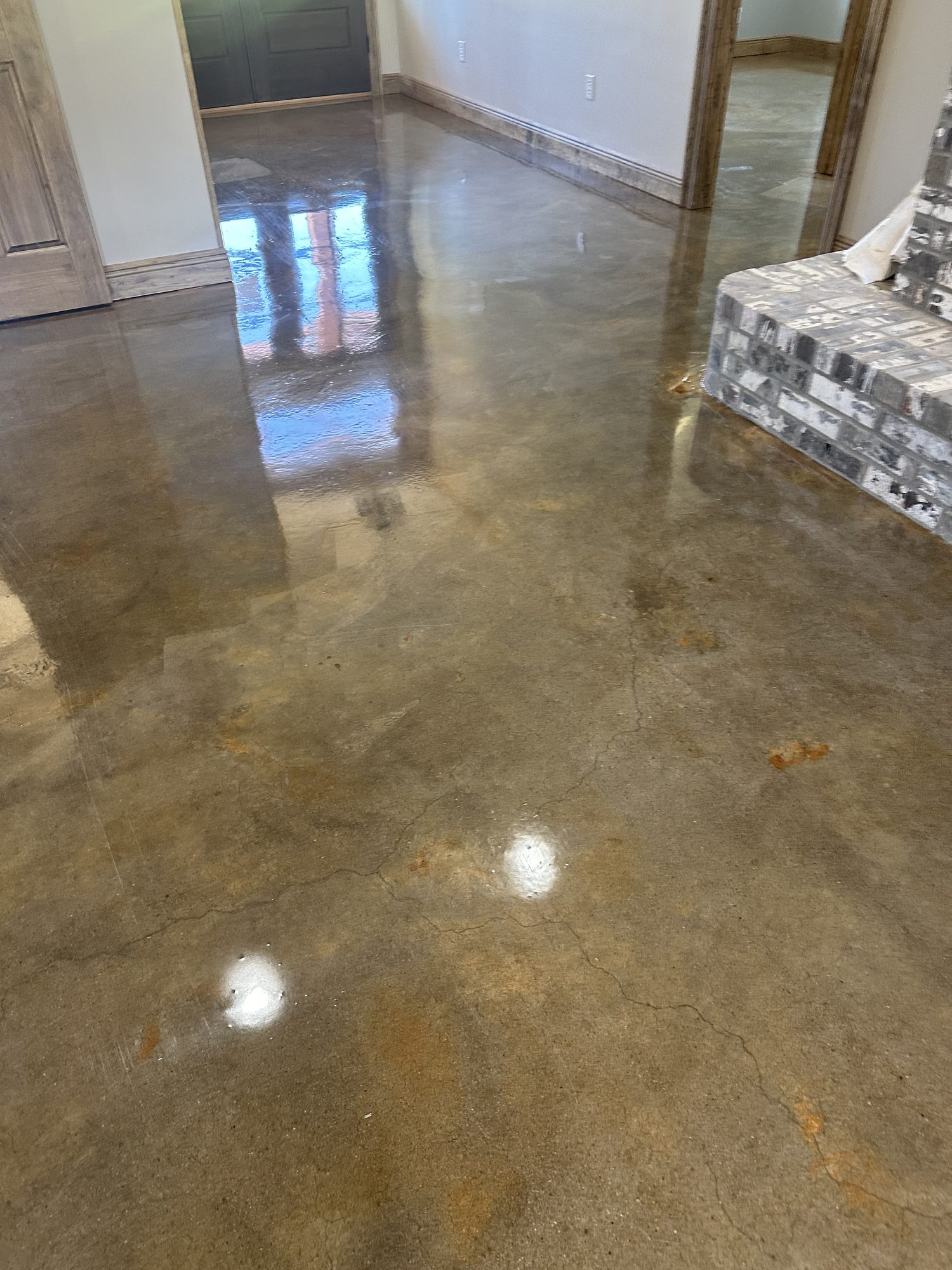
Color that soaks in
and stays put
on a Harvest slab
Acid or water based stain goes into the concrete you already have, and we try the color on your own floor before the whole room gets it.
Talk to KortniFree quote . No obligation . Fast response
Where the color actually goes
Paint and most coatings sit on concrete as a film. Stain works the other way. It soaks into the top of the slab and colors the cement paste itself, so there is no layer to wear through at the door or come loose in a sheet when the floor gets damp. What you walk on afterward is still concrete, only darker or warmer or tinted toward the color you picked.
Acid stain
Acid stain is a reactive product. It works on the lime in the cement, and the color it leaves depends on how much lime sits in each part of the slab. Trowel marks and a patch poured years after the rest both react a little differently from the field around them. The finished floor comes out mottled, with tones that drift across the room the way weathered stone does. Owners who want that look love it. Owners who pictured one even shade tend to be disappointed, and we would rather find that out before the first coat goes down.
Water based stain
Water based stain reacts with nothing. It carries pigment down into the pores and leaves it there, so the result lands closer to the sample and the range runs wider, including colors acid stain cannot reach. It is still translucent and still shows the slab under it. Think of it as a calmer, more predictable version of the concrete you have.
Why the test patch goes on your floor
A color chart is printed on paper, and paper has no lime in it. The same stain can dry a shade lighter on one slab and noticeably browner on the next, because the age of the concrete, how hard it was troweled and what has soaked into it over the years all change how it takes color. A chart has no way to account for any of that.
So before we stain a room, we lay a test patch on the actual floor, somewhere out of the main line of sight. You see it dry, on your concrete, in the light that room really gets. If it misses, we adjust the color or switch from acid to water based and try again.
The patch also tells us whether the slab will take stain evenly at all. A spot that stays pale while the rest darkens means something is sitting in the pores, usually an old sealer or the cure and seal sprayed on the day the slab was poured. That layer gets ground off before any color goes down. If you want a patch done on your slab, tell us where the floor is and what you have in mind.
Older homestead floors and their history
Harvest mixes newer subdivision slabs with older homesteads on acreage, and the older floors are where staining gets interesting. A farmhouse slab that spent decades under carpet or a workbench keeps its whole history in the pores, and a translucent color brings that history forward.
- Spots already in it. Oil, rust and pet stains soak in deep. Under stain a dark spot stays dark, only tinted.
- Patches. A repair poured later is a different mix with different lime, and acid stain colors it differently from the slab beside it.
- Old adhesive. Carpet and tile glue block stain completely. It comes off with the grinder, and a ground area can take color a touch lighter than the rest.
- Cracks. Stain runs into a crack and darkens it, so it reads as a line across the floor. Some owners like that. Others want it filled first.
Stain shows you the floor you already own, a little deeper in color, with its past still in it.
None of this rules an old slab out. It means we walk the floor with you and point out which marks will stay before you choose a color.
Sealing it, and when a coating is the better call
Stain gives color and no protection. Every stained floor gets a sealer over it, which deepens the color and keeps spills from soaking down into the stained layer. Indoors that can be a penetrating sealer or a clear coat. Outside on a patio or an entry slab, it has to be a top coat that holds up in sun, with grit worked in wherever the surface gets wet.
Stain makes the most sense on a homestead floor you want to keep as concrete, or on a covered patio or entry that should look warmer than bare gray. A garage that sees oil and hot tires every day is a different job, and a coating usually serves it better. So does a slab too damaged for a translucent color to live with, and resurfacing can give that one a clean surface to stain. The whole process is on our concrete staining page, and finished stained floors are in the gallery.
To see what your slab does with color, ask us to come test it or call (205) 238-8111. Harvest is inside our normal run out of Huntsville with no travel charge, and the rest of what we install there is on the Harvest page.
Questions about staining a Harvest slab
Most of these come up on the first walk across the floor.
Will stain hide the marks already in my floor?
No. Stain is translucent, so anything already in the concrete shows through, only tinted. Light marks often blend into the mottling of an acid stain. Deep oil and rust spots stay visible. If hiding them matters more than keeping the look of concrete, a coating or an overlay is the better answer.
Can stain go over a floor that has been painted?
Not over the paint. Stain has to reach bare concrete to work, so paint, sealer and old glue all get ground off first. Grinding opens the surface, which helps the color take, though a ground area can come out slightly different from concrete that was never touched. The test patch shows us how much.
Does stain hold up outside on a patio?
Yes. The color is in the concrete, so weather does not strip it. The sealer over it takes the beating, so outdoors we use a top coat that stays clear in sunlight and add grit where water collects. A covered patio is easier on that sealer than one out in the open.
Will the color match the chart?
Rarely, and acid stain least of all. The chart points you in a direction. Your slab’s age, its finish and what has soaked into it decide where the color actually lands, which is why we test on the floor itself. Water based stain gets closer to the chart if an exact match matters to you.
Can a stained floor be polished too?
Yes, and the two work well together. We grind the slab, bring in the color partway through the grit sequence, and keep polishing, so the gloss comes from the concrete with the color under it. That suits an interior homestead floor better than a patio, where a sealed finish is easier to look after.
Does stain work on a brand new subdivision slab?
It can, once the slab has cured and any cure and seal from the pour has been ground off. New concrete tends to take stain more evenly than an old floor, so the result is calmer, with less of the mottling people choose acid stain for. Water based stain often suits a young slab well.
The other Harvest systems
Curious what color your slab will take?
Call (205) 238-8111 and we will set up a test patch on a corner of the floor, so you choose from your own concrete.