
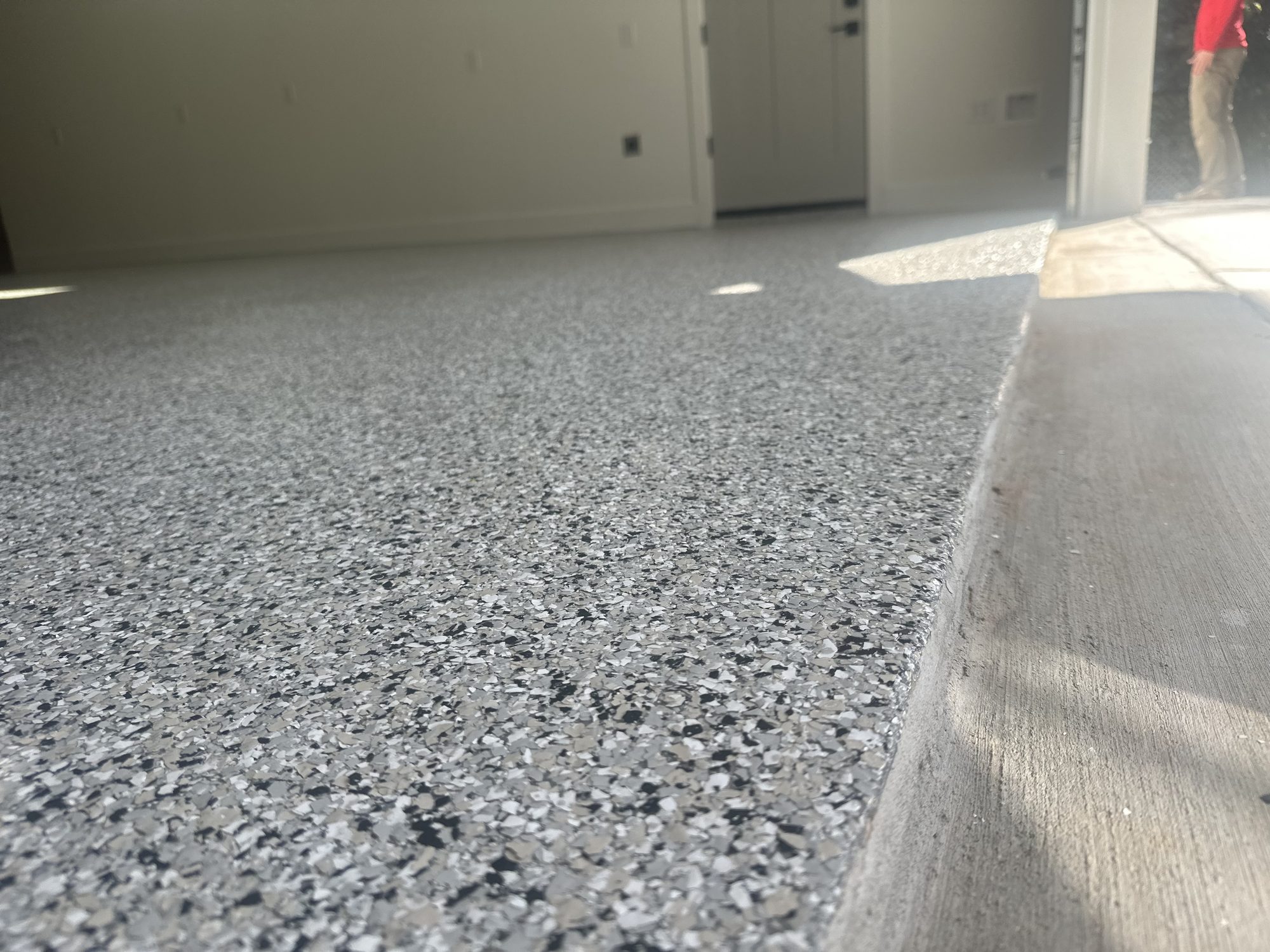
Harvest garages,
shops on the back acreage
and the porch out front
Chip goes into a wet base by the handful until the floor refuses more, then a clear coat picked for that space locks it in.
Talk to KortniFree quote . No obligation . Fast response
A garage slab poured last year
Harvest keeps filling in as houses spread out from the north side of Madison County, and plenty of the floors we get called to there sit under garages that are close to new. Owners tend to assume young concrete can take anything. It is usually the soundest slab they will ever have, and it still gets the full prep.
A new slab often comes from the builder with a smooth, tight top skin, and sometimes a curing compound sprayed over it. Resin grips neither one. Diamond grinding takes that skin off and opens the pores, so the base coat soaks in instead of sitting on the surface waiting to let go.
Young concrete also holds a share of the water it was mixed with. Before we put flake on a new build garage, we check how much moisture is still rising through it. If that check says wait, we tell you to wait, and the floor goes down once the slab has given up enough of it.
Past that point, a new garage is about the easiest flake floor there is. Our flake epoxy flooring page walks through the system coat by coat.
Shop floors out past the house
Plenty of Harvest properties are older homesteads on acreage, and out there the largest slab on the property is often a detached shop or an outbuilding. Those slabs take the same flake system a garage gets. What changes is everything around it.
Older shop slabs may not have a vapor barrier under them, and some sit low enough that rain runs in under the door. That makes the moisture check on an outbuilding more than a formality, so we look at where water goes around the building as well as what the concrete itself shows.
A shop that sees equipment usually gets a larger chip and a darker, busier blend, because that floor will carry oil drips and dragged dirt between washdowns. If there is a shop and a garage on the same property, ask us to look at both on one trip; they can often be done back to back.
A porch finished right to the door sill
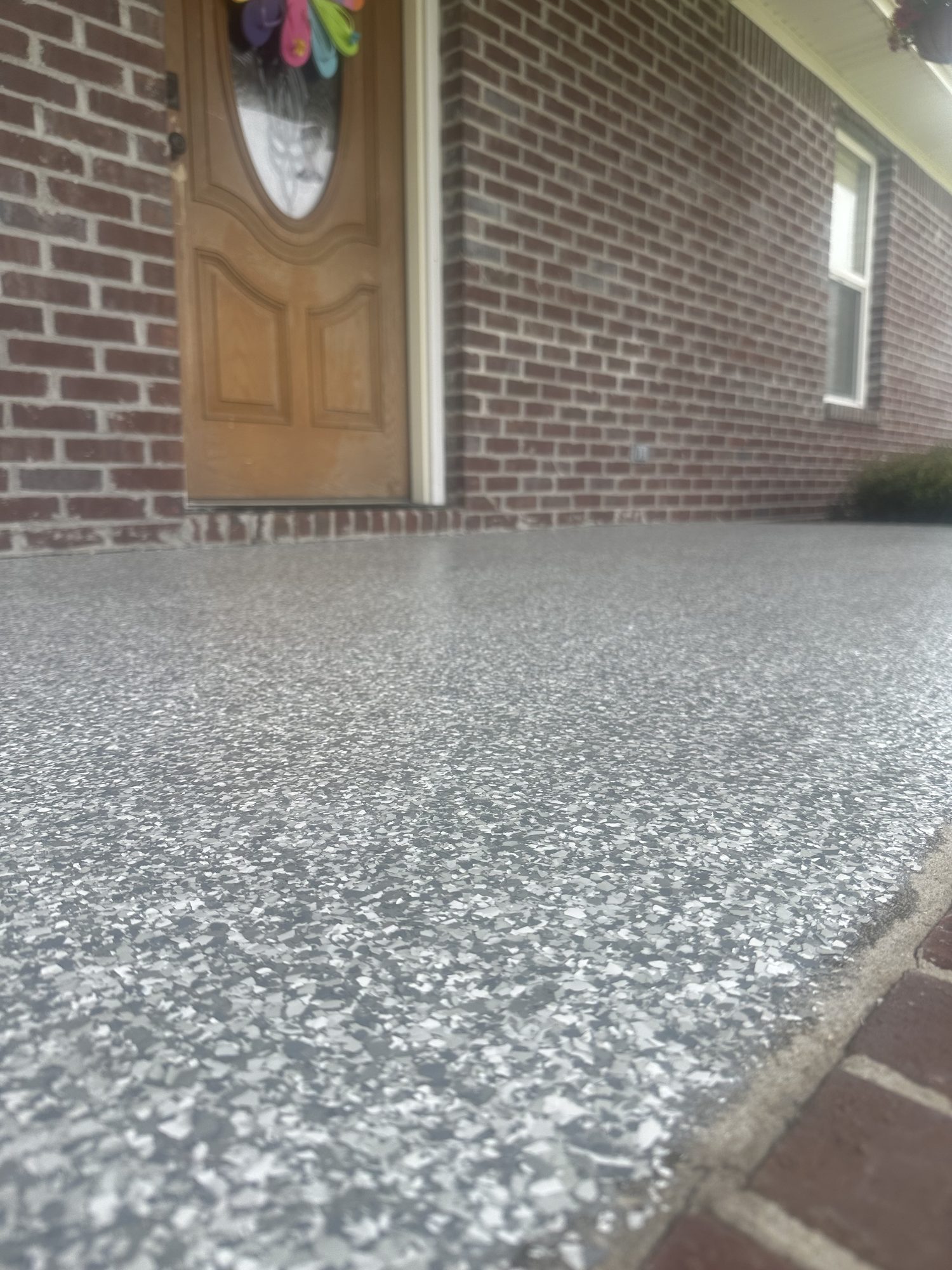
Flake works outdoors as long as the top coat is built for it. On the porch in this photo, gray and white chip covers the slab beside the brick and runs right up to the sill of a wooden front door, so there is no bare strip at the threshold for water or dirt to find.
Sun is the problem a garage never has. Ordinary epoxy yellows under UV, so porches get a UV stable top coat that keeps a gray blend gray. The grit mixed into that coat is set by how wet the surface gets: a deep covered porch needs less, and a slab that takes rain head on needs more.
A porch is the first floor a visitor stands on, so the line at the door gets more care than any edge in the garage.
Porch concrete has usually weathered longer than the garage slab, so it can need more grinding and patching first. If the surface is scaled or pitted past what a coating should cover, start with our Harvest concrete resurfacing page, then flake can go over the new surface. A coated porch cleans with a hose and a soft brush, and the clear coat keeps pollen and leaf stain on the surface where it rinses away.
Chip, the door line, and two floors we turn down
Most of the choices on a flake floor are yours. Two of them are ours, and we make those before anyone signs anything.
- Chip size. Larger chip looks busier and buries more grime between sweeps. Smaller chip looks finer and tighter, closer to stone, and suits a porch people see up close.
- Blend. Choose it for what the floor holds. A light mix keeps a dark garage bright and shows less dust; a darker one hides tracked dirt and tire marks.
- The door line. Where the garage door comes down, the coating ends in a clean, straight edge at the slab. It meets the driveway without a ragged lip for water to sit behind.
- A wet slab. If water is still moving up through the concrete, a sealed coating will lift. We will not flake it until that is solved.
- A moving crack. A crack that opens and closes through the year will break back through any chip. It gets dealt with first, or the floor waits.
We bring blend samples to the quote so you can hold them against your brick, trim and garage door. Bring paint colors from the house if you have them. Finished floors are in the gallery. To get a look at yours, tell us about the slab or call (205) 238-8111, and the rest of what we install around town is on our Harvest page.
Our house is brand new. Is the garage slab ready for flake?
Often it is, after grinding. New concrete can still carry a builder’s curing film and more moisture than an older slab, so we grind the surface open and check how much water is coming up before booking anything. If the slab needs more time, we say so plainly and come back when it is ready.
Can the shop and the garage share the same blend?
Yes, and plenty of people do it so the property reads as one set of buildings. A shop may suit a bigger chip than the garage even in the same colors, since it sees heavier dirt. We can run both floors in one block of consecutive days when the slabs are ready together.
Is a flake porch slippery when it rains?
The chip gives some texture on its own, and outside we add grit to the top coat as well. How much depends on how exposed the porch is. More grit means better footing in a downpour and a little more effort with the mop, so we set it to the spot.
Will you come out to Harvest for one garage?
Yes. Harvest is in Madison County, well inside the 100 miles we cover from Huntsville, and there is no travel charge for being there. A single garage gets the same crew and the same prep as a big job. Call or send a photo and we will set a time to see it.
Can a trailer jack or a mower damage the floor?
A properly bonded flake floor handles rolling weight well, but a narrow steel foot can press a mark into it over time. Put a small square of plywood under trailer jacks and jack stands. Tires from a mower or tractor are no trouble. Drag nothing with a sharp edge, and the floor will shrug off the rest.
What has to come out before you start?
Everything that touches the slab, including shelving legs, bins and the fridge many people keep out there. Wall cabinets can stay if nothing hangs low enough to block the edge. Clearing it fully is what lets the coating run tight to every wall. For a shop, that means the equipment rolls outside for the duration.
The other Harvest systems
Garage, shop or porch in Harvest?
Tell Kortni what the slab is, how big it runs and what it carries, and we will set a time to see it in person.